

Rapid fabrication of optical elements for sensing applications
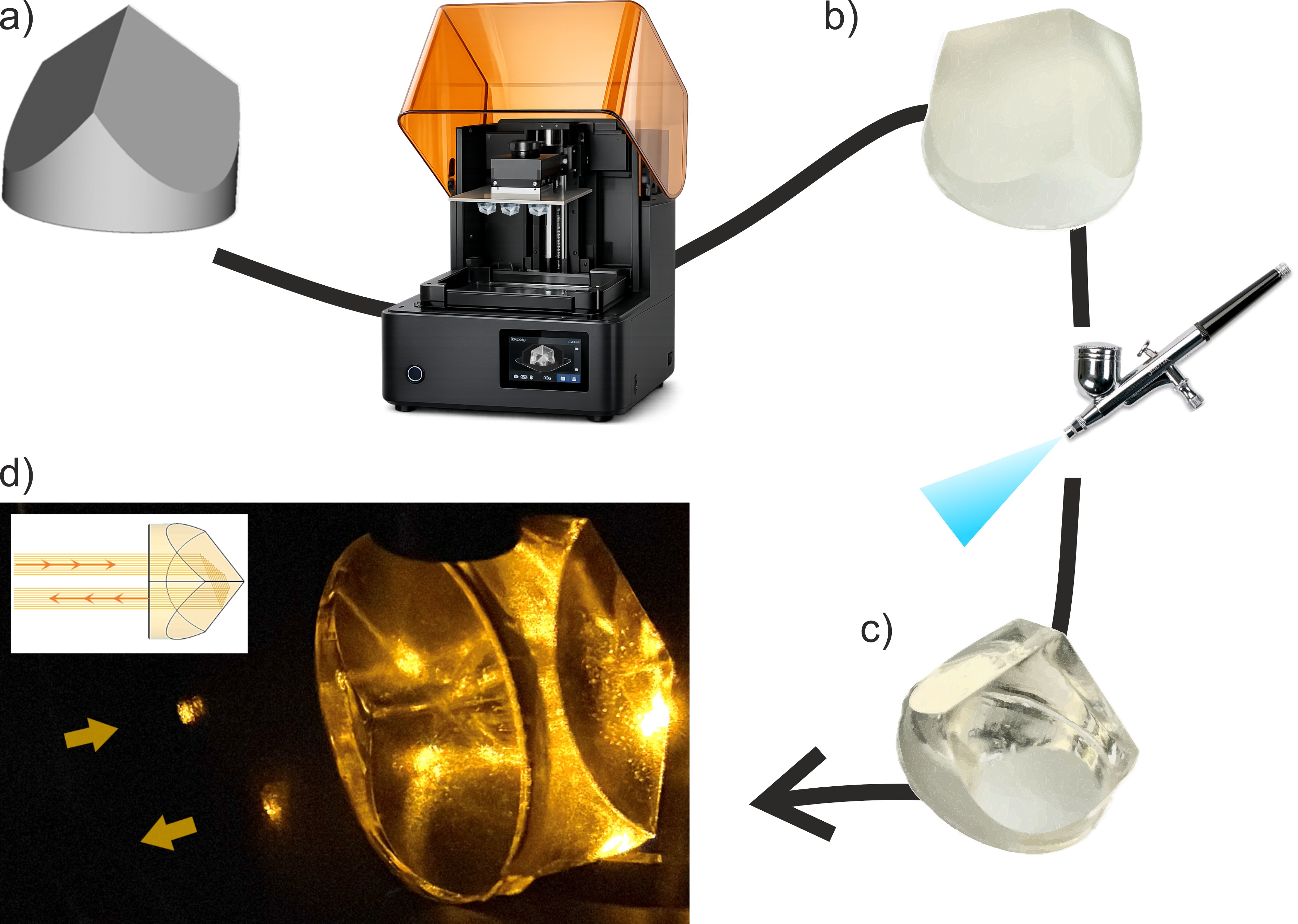
a, computer-aided design of a retroreflector prism. b 3D printing of the element with cloudy surface; c clear and smooth element after post-treatment; d validation of the design and manufactured prism by testing the retroreflection of a laser beam at 589
GA, UNITED STATES, April 21, 2026 /EINPresswire.com/ -- This work describes a cost-effective method for fabricating lenses and free-form optics with a stereolithography 3D printer. Transparent resins were systematically characterized regarding their optical and surface properties. Using robust but simple printing and post-processing protocols, elements with high transmittance, low autofluorescence, and high-surface quality were fabricated with high fidelity and reproducibility. Demonstrations of fluorescence sensing systems showed improved signal performance and the potential for rapid prototyping of miniature optical applications.
The growing demand for compact, high-performance optical systems has sparked interest in free-form optics. Free-form optics enable flexible light manipulation and compact device design. However, conventional fabrication methods are expensive, complex, and inaccessible to non-specialists. Additive manufacturing, particularly vat photopolymerization, offers a promising alternative because it is low-cost, accessible, and capable of producing complex geometries.
This work systematically evaluates six commercially available transparent photopolymer resins suitable for 3D printing to address these limitations. It focuses on key optical and structural properties, including transmittance, autofluorescence, refractive index, and surface quality.
To avoid printing artefacts and defaults, we optimized the printing parameters and developed a simple yet effective post-processing protocol to obtain suitable optical elements. Rather than using conventional abrasive polishing, a thin layer of the same resin was applied via spray coating or brushing and then cured with UV light. This approach smoothed surface irregularities, significantly improving optical clarity while maintaining consistent material properties. The resulting surface roughness was comparable to that achieved with more complex polishing techniques, and dimensional accuracy remained within the micrometer-scale deviations typical of commercial optics.
Optical characterization revealed that most resins attained transmittance values of around 85%, approaching the values of standard optical plastic materials, such as PMMA and COC. Further improvements were obtained by curing under an inert atmosphere, which minimized undesirable reactions with oxygen during polymerization and reduced yellowing. This process increased transmittance to nearly 90% for several resins.
Autofluorescence, a critical parameter to be avoided in fluorescence-based sensing, varied significantly between materials. Some resins exhibited minimal intrinsic fluorescence across the relevant spectral range, making them suitable for optical sensing applications. Others showed stronger emissions due to residual photo-initiators or stabilizers. The measured refractive indices (1.44–1.53) were comparable to those of common optical polymers and glasses. This allows for the rapid transfer of existing optical designs to printed components.
To validate this approach, we integrated the fabricated optical components into miniaturized analytical systems. In two cases, 3D-printed lenses replaced conventional glass optics in previously published fluorescence-based devices. The printed "twin" lenses demonstrated comparable performance, producing calibration curves and measurement precision similar to those obtained with commercial optics. In a third case, newly designed free-form optics were introduced into a compact detection system, resulting in improved signal collection and sensitivity.
These demonstrations confirm that, with proper optimization, 3D-printed optics can match traditional components, allowing for the rapid prototyping and customization of optical elements that are tailored to specific device geometries without requiring specialized fabrication infrastructure. Additionally, the printed components showed good reproducibility and long-term stability, supporting their practical applicability.
In summary, this study establishes vat photopolymerization printing as a viable and accessible method for producing high-quality optical components. The combination of material selection, optimized printing parameters, and effective post-processing allows for the creation of transparent, low-fluorescence, geometrically precise optics. This approach significantly reduces the barriers to developing custom optical systems and supports innovation in miniature sensing, imaging, and photonic devices across a wide range of disciplines.
References
DOI
10.37188/lam.2026.024
Original Source URL
https://doi.org/10.37188/lam.2026.024
Funding information
This work was supported by Bundesanstalt für Materialforschung und -prüfung (BAM) under the grant number IE2211.
About Light: Advanced Manufacturing
The Light: Advanced Manufacturing is a new, highly selective, open-access, and free of charge international sister journal of the Nature Journal Light: Science & Applications. It will primarily publish innovative research in all modern areas of preferred light-based manufacturing, including fundamental and applied research as well as industrial innovations.
Lucy Wang
BioDesign Research
email us here
Legal Disclaimer:
EIN Presswire provides this news content "as is" without warranty of any kind. We do not accept any responsibility or liability for the accuracy, content, images, videos, licenses, completeness, legality, or reliability of the information contained in this article. If you have any complaints or copyright issues related to this article, kindly contact the author above.
